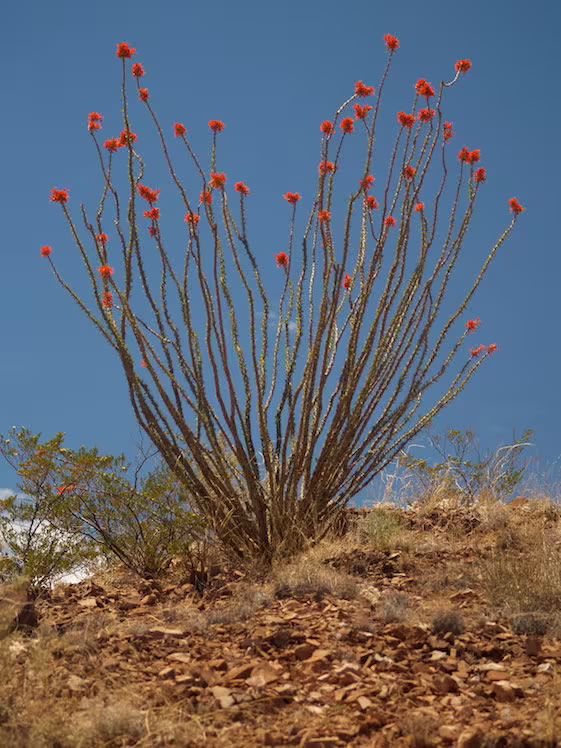
Three 10 inch cuttings, Desert Ocotillo cuttings (unrooted). Beautiful orange/red blooms in spring.
Note: If you dont know how to grow cuttings, we recommend searching YouTube for “how to grow ocotillo cuttings” they have a lot of awesome videos that show details of how to grow them.
Fouquieria splendens (commonly known as ocotillo American Spanish: , but also referred to as coachwhip, candlewood, slimwood, desert coral, Jacob’s staff, Jacob cactus, and vine cactus) is a plant indigenous to the Sonoran Desert and Chihuahuan Desert in the Southwestern United States (southern California, southern Nevada, Arizona, New Mexico, Texas), and northern Mexico (as far south as Hidalgo and Guerrero).
Ocotillo is not a true cactus. For much of the year, the plant appears to be an arrangement of large spiny dead sticks, although closer examination reveals that the stems are partly green. With rainfall, the plant quickly becomes lush with small (2–4 cm), ovate leaves, which may remain for weeks or even months.
Individual stems may reach a diameter of 5 cm at the base, and the plant may grow to a height of 10 m (33 ft). The plant branches very heavily at its base, but above that, the branches are pole-like and rarely divide further, and specimens in cultivation may not exhibit any secondary branches. The leaf stalks harden into blunt spines, and new leaves sprout from the base of the spine.
The bright crimson flowers appear especially after rainfall in spring, summer, and occasionally fall. Flowers are clustered indeterminately at the tips of each mature stem. Individual flowers are mildly zygomorphic and are pollinated by hummingbirds and native carpenter bees.